


HTX Research, the specialized research arm of world-leading cryptocurrency exchange HTX, has released its latest report, “Prediction Markets: From Structural Bottlenecks to Infrastructure Revolution and the Future of Hot Assets,” providing a structured analysis of the foundations, development trajectory, and long-term potential of prediction markets. This study discusses why prediction markets continue to face structural limitations despite their rapid growth, and whether prediction markets can ultimately become the pricing infrastructure for attention-based assets.
Prediction markets as a hot emerging economy: a sharp contrast with meme coins
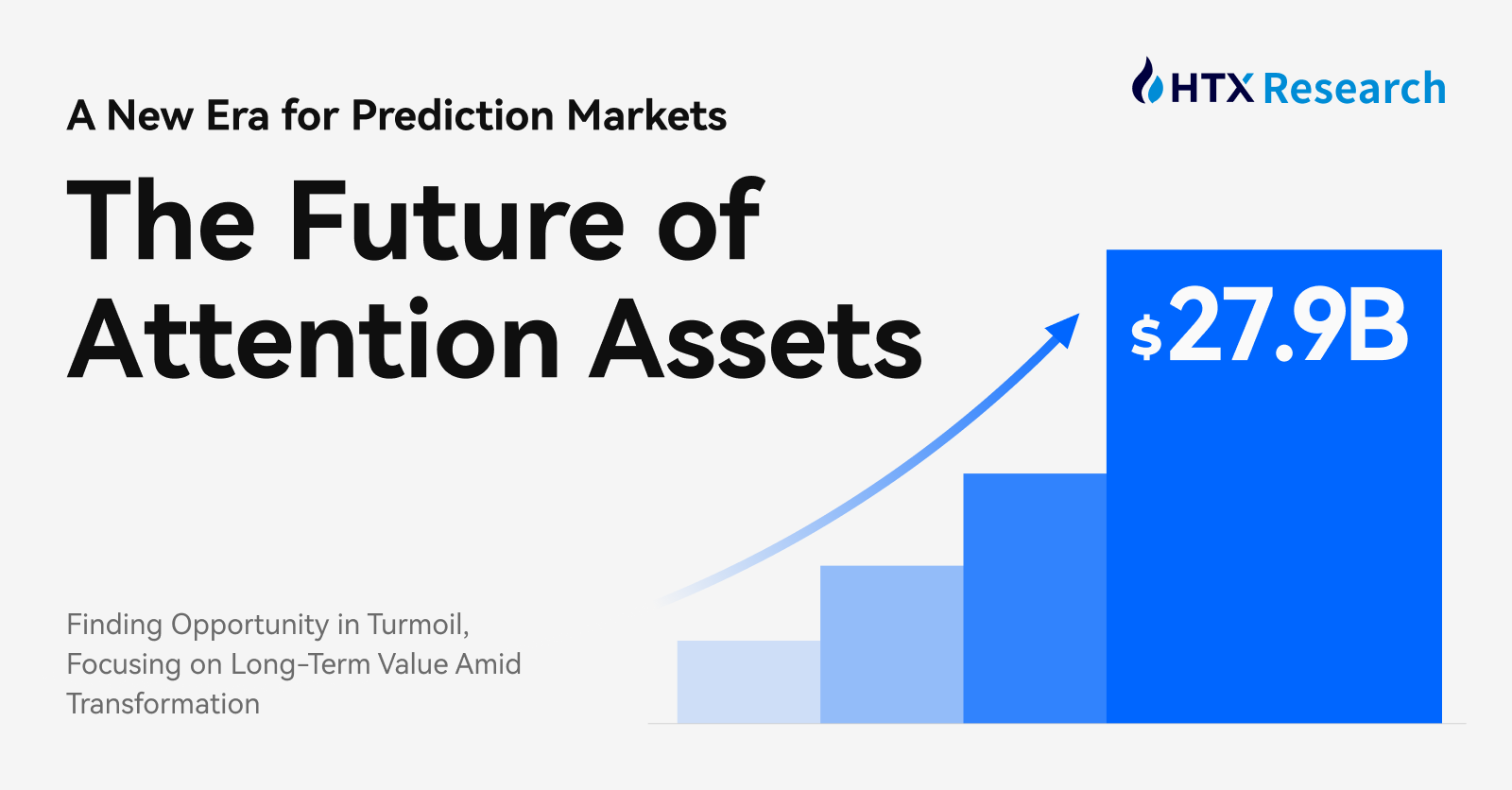
Prediction markets are growing rapidly. In the first 10 months of 2025, global trading volume reached $27.9 billion, an increase of 210% from 2024. Similar to meme coins, prediction markets have a high concentration of small-cap participants. However, the two operate through fundamentally different mechanisms.
Prediction markets allow participants to allocate small amounts of money to multiple events with transparent odds and clear downsides. Event structures allow informed users to turn domain knowledge into measurable profits, especially in illiquid markets where information gaps create opportunities.
Memecoin transactions follow a different pattern. Pump.fun creates 10,417 tokens every day, 98.6% of which are identified as manipulated, and typically last less than three months. Prices fluctuate primarily based on social momentum rather than probability. Information asymmetry heavily favors token creators and leaves ordinary users reliant on hype cycles rather than informed insights.
Prediction markets also spread through social channels, but their traction comes from the dynamics of evolving events rather than spikes in emotion. For most participants, prediction markets function as information-based competitions, whereas meme coins are more like attention-seeking lottery tickets.
Rapid growth and underlying structural weaknesses
Despite the increase in participants, prediction markets remain structurally weak. Liquidity on many platforms still relies on incentives. Some used to spend more than $50,000 a day on market-making subsidies, but that depth has shrunk as incentives have declined. As loss outcomes settle to zero, it becomes difficult for the market to accumulate permanent depth, and as things get closer to resolution, informed traders gain increasingly favorable pricing and market makers’ losses increase.
Other structural limitations also remain. Binary formats have limited expressive power. Discovery is weak when the market is thin. Creation of events without permission is restricted. And Oracle’s payment processes face risks of delay and tampering. These challenges demonstrate that prediction markets are still in the early stages of infrastructure development.
Structural innovation signals the next stage
New system designs are emerging to address these constraints. Just-in-time liquidity injects capital only when needed, increasing efficiency. Continuous combinatorial markets reduce fragmentation because views can be expressed across a continuous range rather than in isolated binaries.
New forecasting structures, including perpetual contracts built on predictive market data and fast-settlement binary formats, extend expressive power beyond traditional designs. Distribution is also evolving. Stochastic path charts are a natural fit for social feeds, and new platforms are increasingly embedding trade flows into social networks, turning prediction markets into “financial formats” distributed through attention channels.
These innovations do not immediately solve all structural challenges, but they do signal a shift toward more scalable architectures.
The rise of attention-based finance
HTX Research points out that hot assets are becoming the third major asset class after cash flow assets and supply and demand assets. Representative tokens within this category include BAT, KAITO, etc. According to HTX data, BAT has risen more than 30% in the past 30 days and KAITO once hit the market in H1 2025.
In addition to these projects, HTX Research suggests that prediction markets could become the core pricing infrastructure for hot assets. Existing user-generated featured assets such as NFTs and creator tokens start from scratch and fail to capture established cultural associations. In contrast, prediction markets generate time-based price and liquidity signals that can be aggregated into a featured index that reflects real-world visibility.
Such an index has several advantages. Actual capital is required to operate the index. Existing attention can be expressed without starting from scratch. Participants can then take long or short positions as their attention shifts. As this framework matures, prediction markets may evolve from a tool for predicting outcomes to an infrastructure that can measure and price cultural relevance, a supporting vehicle such as Attention Perpetual.
conclusion
Prediction markets are moving from rapid growth to structural sophistication. Challenges remain, but innovations across fluidity, expressiveness, and distribution are reshaping market design. As attention-based assets become more clearly defined, prediction markets may increasingly serve as a connecting layer between cultural and economic values.
Compared to the emotion-driven volatility of meme coins, prediction markets offer information-driven, probability-based participation. As the architecture matures, its role in the digital asset ecosystem is likely to expand significantly.
HTX Research is the specialized research division of HTX Group and is responsible for conducting in-depth analysis, producing comprehensive reports, and providing expert assessments across a wide range of topics, including cryptocurrencies, blockchain technology, and emerging market trends. HTX Research is committed to providing data-driven insights and strategic foresight, playing a pivotal role in shaping the industry landscape and supporting informed decision-making in the digital asset space. Through rigorous research methodologies and cutting-edge analysis, HTX Research remains at the forefront of innovation, driving thought leadership and fostering a deeper understanding of evolving market dynamics. Please visit our website.
